
Understanding scope of practice
‘Scope of practice’ refers to the specific areas of knowledge, skills, and experience a practitioner requires to perform their duties competently, safely, and lawfully. This ensures that the practitioner meets professional standards and does not pose any danger to the public or themselves.
The national body for Outdoor Health practices, Outdoor Health Australia (OHA), acknowledges that a practitioner’s ‘Scope of practice’ evolves over time. As practitioners gain more experience, their practice often becomes more focused and specialised compared to when they were newly qualified. This specialisation is influenced by various factors, like working with a particular client group, developing specific skills, or transitioning into roles that involve management, education, or research.
This statement is adapted from the Australian Association for Social Work and Psychotherapy and Counselling Federation of Australia’s statements on Professional scope.
Scope of practice is determined by the relevant professional regulatory framework/s or industry standards (e.g. PACFA registration, Australian Adventure Activity Standards) relating to an individual’s practice or services offered. Practitioners practicing within an accredited discipline must retain this basis of accreditation.
Australian outdoor health pathways for practitioners
Outdoor Health Australia provides these examples of existing pathways towards safe, ethical and effective practice within the scope of practitioner competencies and qualifications. Examples of therapeutic fields include psychology, social work, counselling, occupational therapy, physiotherapy, etc.
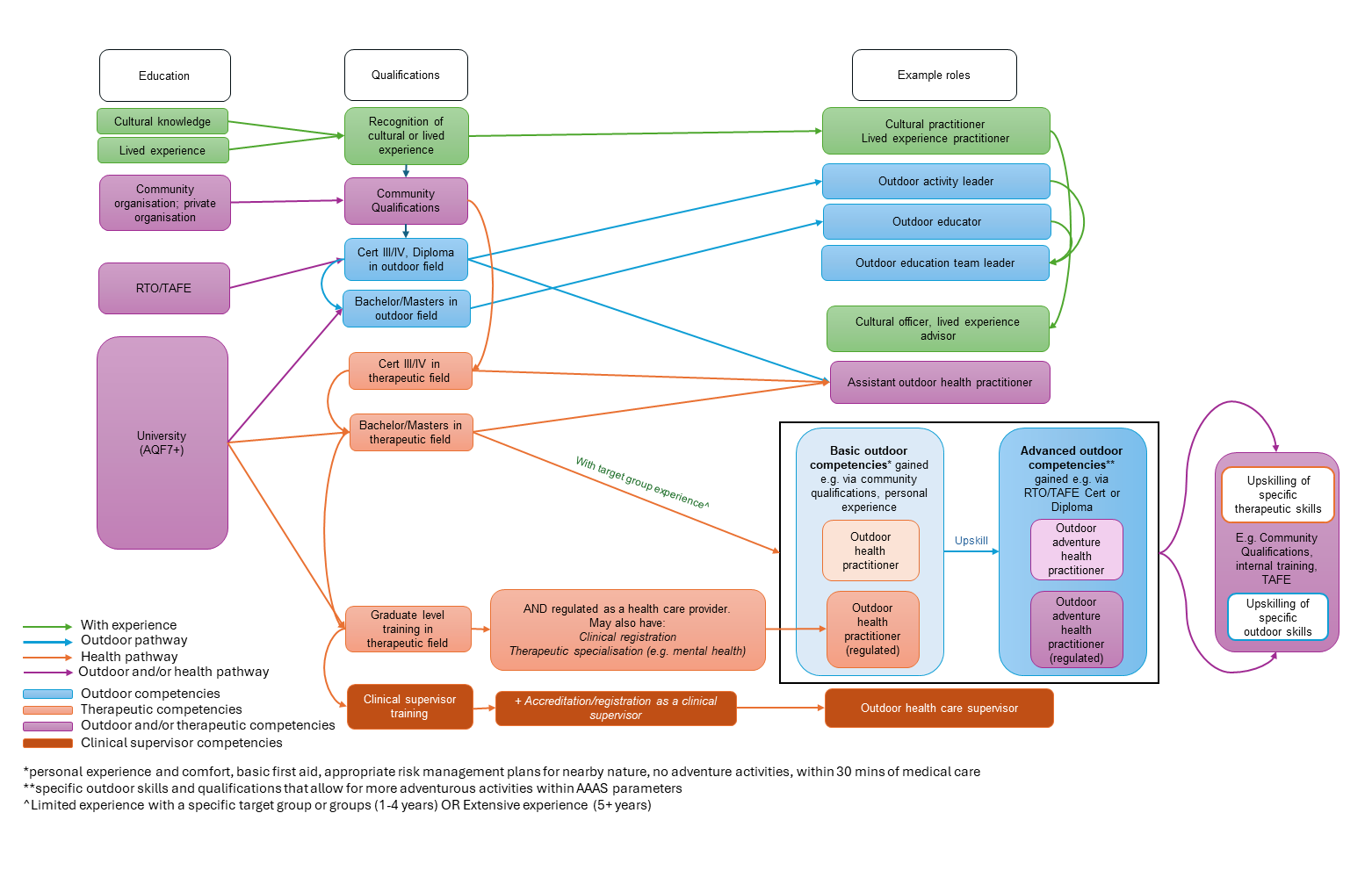
For those who are seeking to work as an outdoor health practitioner, but who do not have qualifications at an AQF7 level, meeting the following standards is recommended:
- National Police Check
- State-based WWCC (of equivalent) registration
- Character reference from someone who has known them professionally for 5+ years
- CV demonstrating 5+ years of safe, effective, evidence-informed and supervised practice
- Demonstrated evidence of Aboriginal community linkages, Lived experience expertise and/or knowledge of a specific target group or cohort
- Demonstrated evidence of relevant personal outdoor experience and competence across diverse natural environments in a range of conditions that are relevant to your practice (for example, logged)
- Demonstrated evidence of relevant personal therapeutic training or experience and competence within a range of therapeutic contexts that are relevant to your practice (for example, logged)
- Commitment to ongoing supervision and professional development
Community qualifications
Community qualifications sit outside of the Australian Qualification Framework. They may vary widely in content and quality. Currently OHA does not endorse specific community qualifications, training or training providers. We recommend consideration of the following when considering engaging with a community training provider:
- Evidence base for training content, models and approaches
- Scope of practice (Is this made clear? Are you encouraged to define and reflect on this?)
- Alignment with relevant legal and sector standards (where available)
- Alignment with OHA ethical principles