
Building competence in outdoor health requires developing skills across multiple domains of competence. This page provides information about Australian qualifications and training relevant to outdoor health practice.
Outdoor health services can support people across the continuum of care – from prevention and health promotion and therapeutic wellbeing services through to early intervention, treatment, and recovery support. Services may be delivered in various contexts including public health programs, primary care, allied health services, mental health services, disability support, and community-based wellbeing programs and services.
Outdoor health in the Australian health sector
There is no single qualification pathway for outdoor health practice. The field welcomes practitioners from diverse backgrounds who bring different strengths to create integrated, nature-based interventions. Determining suitable qualifications and experience for outdoor health practice is dependent on many considerations which are detailed below.
Outdoor health practice typically involves:
- Developing depth in one competency area through formal qualifications (therapeutic OR outdoor)
- Building breadth across other competencies through additional training, experience and supervision
- Exploring options for combining qualifications through double degrees, majors/minors, strategic elective selection, or postgraduate specialisation
- Cultivating specialised expertise with specific populations, settings or approaches
- Maintaining ongoing professional development across all relevant domains
Australian outdoor health pathways for practitioners
Outdoor Health Australia provides these examples of existing pathways towards safe, ethical and effective practice within the scope of practitioner competencies and qualifications.
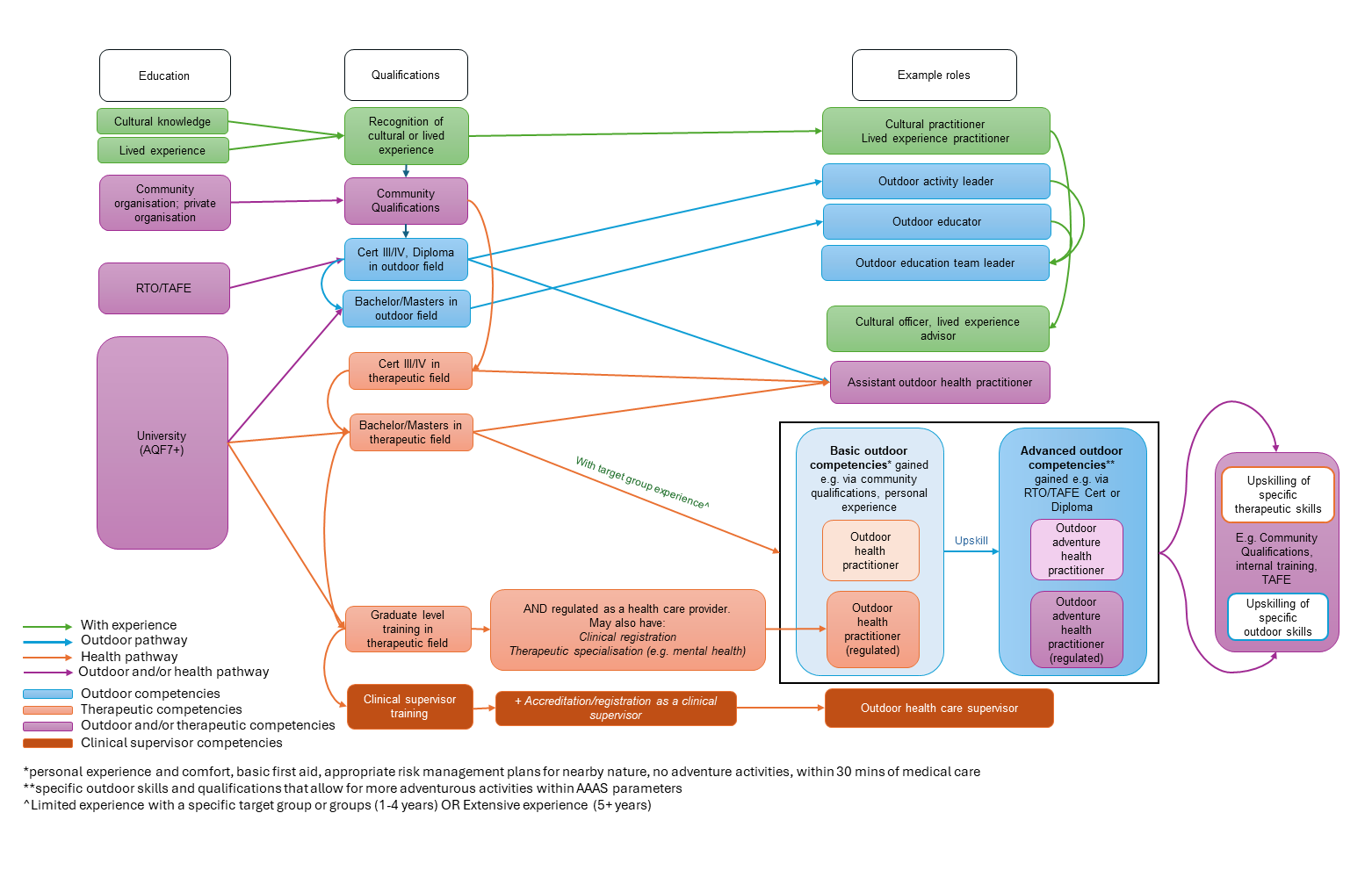
Understanding scope of practice
‘Scope of practice’ refers to the specific areas of knowledge, skills, and experience a practitioner requires to perform their duties competently, safely, and lawfully. This ensures that the practitioner meets professional standards and does not pose any danger to the public or themselves.
The national body for Outdoor Health practices, Outdoor Health Australia (OHA), acknowledges that a practitioner’s ‘Scope of practice’ evolves over time. As practitioners gain more experience, their practice often becomes more focused and specialised compared to when they were newly qualified. This specialisation is influenced by various factors, like working with a particular client group, developing specific skills, or transitioning into roles that involve management, education, or research.
This statement is adapted from the Australian Association for Social Work and Psychotherapy and Counselling Federation of Australia’s statements on Professional scope.
Scope of practice is determined by the relevant professional regulatory framework/s or industry standards (e.g. PACFA registration, Australian Adventure Activity Standards) relating to an individual’s practice or services offered. Practitioners practicing within an accredited discipline must retain this basis of accreditation.
For those who are seeking to work as an outdoor health practitioner, but who do not have qualifications at an AQF7 level, meeting the following standards is recommended:
- National Police Check
- State-based WWCC (of equivalent) registration
- Character reference from someone who has known them professionally for 5+ years
- CV demonstrating 5+ years of safe, effective, evidence-informed and supervised practice
- Demonstrated evidence of Aboriginal community linkages, Lived experience expertise and/or knowledge of a specific target group or cohort
- Demonstrated evidence of relevant personal outdoor experience and competence across diverse natural environments in a range of conditions that are relevant to your practice (for example, logged)
- Demonstrated evidence of relevant personal therapeutic training or experience and competence within a range of therapeutic contexts that are relevant to your practice (for example, logged)
- Commitment to ongoing supervision and professional development
Where can I find the Training I want?
Use these quick links to jump to the information you need:
Relevant Australian Qualifications (AQF*)by Competency Area
Use these collapsible sections to explore examples of qualifications in each competency area:
People and Therapy Skills
These qualifications develop therapeutic and interpersonal skills for supporting people’s wellbeing, learning, and development across health, education, and community service contexts. Qualifications range from entry-level certificates for supervised roles through to degree-level qualifications required for independent clinical practice.
NB these are examples, not a comprehensive list
Health, Community and Social Services
VET* level training – Health, Community & Social Services
- Certificate III (CHC32015) & IV (CHC42021) in Community Services
- CHC43121 Certificate IV in Disability Support
- CHC40321 Certificate IV in Child, Youth and Family Intervention
- CHC40421 Certificate IV in Youth Work
- Certificate IV (CHC43415) & Diploma (CHC53415) in Leisure and Health
- Certificate IV (CHC43015) in Ageing Support
- Certificate IV(CHC43215), Diploma (CHC53215) in Alcohol and Other Drugs
- Certificate IV(CHC43315, Diploma (CHC53315) in Mental Health
- Certificate IV (CHC43515) in Mental Health Peer Work
- Certificate III (HLT30121) & IV (HLT40121) in Aboriginal and/or Torres Strait Islander Primary Health Care
- Certificate IV(HLT40221) & Diploma (HLT50121) in Aboriginal and/or Torres Strait Islander Primary Health Care Practice
- Diploma (HLT50221) & Advanced Diploma (HLT60121) of Aboriginal and/or Torres Strait Islander Primary Health Care Management
- Certificate III (HLT33021) & Cert IV (HLT43021) in Allied Health Assistance
- Certificate III (HLT36015) & Cert IV (HLT46015) in Population Health
- – Certificate II (HLT26120), III(HLT36115) & IV (HLT46115) in Indigenous Environmental Health
- Certificate IV (HLT41120) in Health Care
University level training – Health Professions
Degree-level qualifications (AQF 7+) are typically required for independent clinical/health care practice. Many professions offer both 4-year undergraduate (Bachelor) and postgraduate (Masters) entry pathways to the same professional registration.
Key Points:
- Course titles and structures vary between universities
- What matters most is accreditation/approval by the relevant regulatory or professional body
- Both undergraduate and postgraduate entry pathways may lead to the same professional registration
- Some postgraduate programs require prerequisite undergraduate study in related fields
- Consider whether programs include supervised practice/placement hours required for professional recognition
- Check specific professional body requirements for your intended career path
AHPRA-Regulated Professions
These professions require registration with the Australian Health Practitioner Regulation Agency (AHPRA) to practice. You must complete an AHPRA-approved program of study:
- Occupational Therapy: Entry through 4-year Bachelor OR 3-year undergraduate degree + 2-year Masters
- Physiotherapy: Entry through 4-year Bachelor OR postgraduate Masters pathway
- Psychology: 4-year accredited sequence + 2 years supervised practice (internship or postgraduate pathway)
- Speech Pathology
- Aboriginal and Torres Strait Islander Health Practice: Various accredited pathways
Find AHPRA-approved programs of study for all regulated professions
Allied Health Professions with National Accreditation (Not AHPRA-regulated)
These professions have nationally recognised accreditation standards through professional associations rather than government bodies:
- Social Work: Bachelor or Masters pathway
- Courses accredited by Australian Association of Social Workers (AASW)
- Counselling and Psychotherapy: Bachelor or higher qualification from accredited courses
- Courses accredited by Psychotherapy and Counselling Federation of Australia (PACFA) and Australian Counselling Association (ACA)
- Exercise Physiology: Bachelor or Masters pathway
- Courses accredited by Exercise & Sports Science Australia (ESSA)
- Speech Pathology
- Courses accredited by Speech Pathology Australia (SPA)
Professions requiring post-graduate level training
- Family Therapy and Systems Therapy: Postgraduate specialisations
- Check with Australian Association of Family Therapy for approved programs
- Play Therapy: Postgraduate training for mental health professionals
- Courses listed on Australian Play Therapists Association website
- Art Therapy: Masters level training required
- Approved courses listed on Australian, New Zealand and Asian Creative Arts Therapies Association (ANZACATA) website
- Music Therapy: Masters level training required
- Approved courses listed on the Australian Music Therapy Association
Other Health-Related Professions
Recreation Therapy: Bachelor of Health Science (Recreation Therapy) or similar – verify therapeutic content in course curriculum. Australian Recreation Therapy Association
Education/Teaching
VET* level training – Education support
- Certificate III (CHC30121) & Diploma (CHC50121) in Early Childhood Education and Care
- Certificate III (30221), IV (CHC40221)& Diploma (CHC50221) in School Based/Aged Education Support/Care
- SIS40221 Certificate IV in Outdoor and Environmental Education
University level training – Education/Teaching
- Bachelor of Education (Primary, Secondary, P-12)
- Bachelor of Education (Outdoor Education)
- Master of Teaching (Graduate entry pathway)
- Bachelor of Sport, Health & Physical Activity (Outdoor Education)
- Bachelor of Education (Secondary Health & Physical Education)
- Bachelor of Outdoor Education or Outdoor & Environmental Education
Outdoor Skills
Key Considerations:
- Outdoor competencies must be current and regularly practiced – skills deteriorate without use
- Many outdoor qualifications require documented logbook hours in specific activities and environments
- Consider the specific environments and conditions relevant to your practice (remote vs accessible, alpine vs coastal, etc.)
- Professional development and skill maintenance are ongoing requirements
- Activity-specific certifications may be required by insurance providers or employers
VET* level training – Outdoor Skills
These qualifications develop skills in leading outdoor activities, managing groups in natural environments, and coordinating outdoor programs:
Outdoor Recreation and Leadership (VET Sport, Fitness & Recreation)
- SIS20419 Certificate II in Outdoor Recreation
- Certificate III (SIS30619), IV (SIS40621) & Diploma (SIS50421) in Outdoor Leadership
- Certificate IV in Outdoor Recreation
- Diploma of Outdoor Education
Relevant single competency units
These nationally recognized skill sets provide competency in specific outdoor activities and safety systems:
- SISSS00140 Wilderness First Aid
- SISSS00136 Artificial Surface Abseiling
- SISSS00137 Artificial Climbing
- SISSS00138 Challenge Course Leader
- SISSS00139 Challenge Course Supervisor
- SISSS00125 Tracked Horse Trail Ride Guiding
- SISOPLN007 Manage Risk for Outdoor Programs
University level Training – Outdoor Education/Recreation
Outdoor competencies encompass technical skills, risk management, environmental knowledge, and leadership abilities required for safe and effective practice in natural settings. Qualifications range from entry-level activity assistance through to senior program management and specialised technical skills.
- Bachelor of Education (Outdoor Education)
- Bachelor of Sport, Health & Physical Activity (Outdoor Education)
- Bachelor of Education (Secondary Health & Physical Education)
- Bachelor of Outdoor Education or Outdoor & Environmental Education
- Bachelor of Recreation and Outdoor Environmental Studies
NB these are examples, not a comprehensive list
Ecological Competence
Ecological competence encompasses understanding of natural systems, human-nature relationships, and environmental sustainability. This knowledge base supports evidence-informed practice in outdoor health settings. Qualifications range from foundational certificates in conservation and land management through to advanced degrees in environmental science.
NB these are examples, not a comprehensive list
Key Considerations:
- Ecological knowledge should be place-based and relevant to your practice location
- Understanding Indigenous perspectives on country is essential for culturally safe practice
- Environmental knowledge evolves – stay current with climate change impacts and ecosystem changes in your area
- Consider both scientific and experiential ways of knowing about natural environments
- Local field naturalist groups and environmental organizations offer valuable learning opportunities
VET* level training
Agriculture, Horticulture, Conservation & Land Management
- Certificate III(ACH30122) in Agriculture
- Certificate III(AHC30722), IV(AHC40422) in Horticulture
- Certificate III (AHC31424), IV(AHC40924), Diploma(AHC51120), Advanced Diploma(AHC60422) in Conservation & Ecosystem Management
- Certificate III(AHC31522) in On Country Management
- Certificate III(AHC32522) in Aboriginal and Torres Strait Islander Cultural Sites Work
- Certificate III(AHC33822), IV(AHC42122), Diploma(AHC52122) in Permaculture
- Diploma (AHC51222) of Community Group Coordination and Facilitation
Tourism
- Certificate III(SIT30125) in Tourism
- Certificate III (SIT30322) in Guiding
- Diploma (SIT50122) of Travel & Tourism Management
University Level Training
Environmental Science
Degree programs that develop understanding of ecological systems, conservation, and environmental management:
- Bachelor of Environmental Science
- Bachelor of Conservation Biology
- Bachelor of Environmental Management
- Bachelor of Ecology
- Master of Environmental Science/Management
Sustainability and ClImate Related Studies
- Bachelor of Sustainability and Climate Change
- Bachelor of Climate Change and Sustainable Action
- Bachelor of Environmental Engineering
Nature-Based Tourism and Land Management (VET & University)
Qualifications that combine environmental knowledge with visitor engagement and sustainable tourism:
- Bachelor of Tourism
- Bachelor of Tourism (Ecotourism)
- Bachelor of Science (Ecotourism)
Working with Specific Groups
Working effectively with specific populations requires understanding their unique needs, strengths, cultural contexts, and safety considerations. Training requirements range from mandatory foundational awareness (such as cultural competency or child safety) through to specialised professional qualifications depending on your role and practice context.
NB these are examples, not a comprehensive list
Groups
Aboriginal and Torres Strait Islander Peoples
- Cultural competency training
- Engaging with Indigenous communities
- Understanding trauma-informed and culturally safe practice
People with disability
- Social model of disability
- Choice and control principles
- Neurodiversity-affirming practice
- NDIS Practice Standards
Children and young people
- Child safety training
- Working with Children Check (required by law)
Mental health
- Mental Health First Aid
- Trauma-informed practice
- Recovery-oriented frameworks
Culturally and linguistically diverse (CALD) communities
- Cultural competency
- Cross-cultural communication
- Working with interpreters
Older people
- Aged care principles
- Age-appropriate planning
- Dementia awareness
Community Organisations Training (non-accredited)
Community qualifications sit outside of the Australian Qualification Framework. Non-accredited training helps professionals develop skills for working at the intersection of therapy and nature-based approaches.
Why Non-Accredited Training Matters
Professional Development Industry-recognised training courses count toward continuing professional development (CPD) requirements for many professions. Health professionals, psychologists, counsellors, and other practitioners often complete specialised training to improve their practice with nature-based and outdoor approaches.
Specialised and Up-to-Date Content Non-accredited training providers can quickly respond to new practitioner and client needs. They develop specialised content that combines therapy, outdoor practice, and ecological knowledge. This flexibility helps training keep up with the growing outdoor health field.
Building Your Skills If you have depth in one area (therapeutic OR outdoor skills), targeted training helps you build skills in other areas where formal qualifications might not exist.
Practice Pathways without Formal Qualifications
For those seeking to work as outdoor health practitioners without qualifications at degree level (AQF Level 7), building demonstrable competence through alternative pathways is essential. While these pathways bring valuable skills and perspectives to the sector, scope of practice, employment opportunities, insurance options, and funding eligibility (particularly NDIS and Medicare) may be more limited than for degree-qualified or registered practitioners.
Suggested Standards for Practice
- National Police Check State-based
- Working with Children Check (or equivalent) registration
- Character reference from someone who has known them professionally for 5+ years
- CV demonstrating 5+ years of safe, effective, evidence-informed and supervised practice in outdoor health or related fields
- Demonstrated evidence of Aboriginal community linkages, lived experience expertise, and/or knowledge of a specific target group or cohort
- Documented personal outdoor experience and competence across diverse natural environments in a range of conditions relevant to your practice (for example, logged)
- Documented therapeutic training or experience and competence within a range of therapeutic contexts relevant to your practice (for example, logged)
- Commitment to ongoing supervision and professional development
Training Connecting People and Nature
Many specialised training programs focus on combining therapeutic approaches with nature connection and outdoor settings. These may be known by different names:
Nature-Based Therapeutic Approaches
- Nature therapy / Ecotherapy
- Forest bathing / Shinrin-yoku (forest therapy)
- Ecopsychology
- Green care / Green therapy
- Horticultural therapy / Therapeutic horticulture
- Nature and forest school approaches
Animal-Assisted Approaches
- Animal-assisted therapy (AAT)
- Animal-assisted interventions (AAI)
- Equine-assisted therapy / Equine-facilitated therapy
- Equine-assisted learning
- Canine-assisted therapy
Experiential Therapeutic Approaches
- Adventure therapy
- Therapeutic adventure
- Challenge-based therapy
- Nature-based play therapy
Place-Based and Cultural Approaches
- Bush adventure therapy
- Land-based healing
- Cultural connection to country programs
- Therapeutic camping programs
- Nature-based mindfulness and contemplative practices
Activity-Specific Qualifications and Skills – Depending on your outdoor health practice, you may need competencies in:
- Bushwalking and navigation
- Camping and expedition planning
- Mountain biking and cycling activities
- Paddling (kayaking, canoeing, rafting)
- Rock climbing and abseiling (natural environments)
- Rope rescue and technical rescue systems
- Snow sports and alpine environments
- Adventure therapy specific techniques
Community Organisation training programs vary in length, depth, evidence base, relevance to Australian context and recognition by professional bodies. When choosing training, use the evaluation criteria below.
Choosing Quality Training
Non-accredited training varies widely in content and quality.
While OHA is developing criteria to help practitioners evaluate training providers, consider the following when selecting professional development:
- Evidence base – Is the training content supported by research?
- Scope of practice – Does the training help you understand appropriate boundaries?
- Legal and sector standards – Does it align with relevant standards?
- Trainer qualifications – Do trainers have experience in both therapeutic and outdoor work?
- Practical application – Will you get supervised practice opportunities?
- OHA alignment – Does it align with OHA ethical principles and competency framework?
- Professional recognition – Does it count toward CPD requirements for your profession?
- Training structure and duration – Is it long enough to learn safe, competent practice? Is it a good match for your learning style?
- Ongoing support – Is supervision, mentoring, or community of practice available after training?
Finding Training Providers
VET* Qualifications (Certificates and Diplomas)
- Your Career – Search VET courses and providers
- National Training Register – Search for qualifications and training providers
- ASQA Register – Find Registered Training Organizations
- TAFE Institutes – Public providers across Australia
University level (Bachelor degrees and above)
- Course Seeker – Search university programs
- Jobs and Skills Australia – Career and labour market information
- Outdoor Educators Associations e.g.,
Outdoor Health Australia (OHA) Service and Training Directory
- OHA Service and Training Directory -. Training providers offering outdoor health-related professional development can register their courses on the OHA Service and Training Directory. This helps practitioners find professional development opportunities aligned with outdoor health principles.
- Register your training on the OHA directory →
- For practitioners seeking training: The OHA directory may include both accredited qualifications and industry-recognised professional development. Look for training that aligns with your existing skills and professional development goals.
Your Next Steps
Explore OHA Resources
- Quality Framework and Ethical Practice Standards – Guidance for integrating outdoor and therapeutic practice
- Service & Training Directory – Find Outdoor Health service and training providers
- Risk Management for Outdoor Health Practice – Understanding safe practice.
- Insurance for Outdoor Health Practice – Understanding coverage requirements
Join OHA
Become a member to connect with peers, access member events and support the development of quality resources for outdoor health practice.
Learn more about OHA membershipStay connected
Subscribe to our newsletter or follow us on social media (links in footer) for updates and sector news
Definitions*
VET – Vocational Education and Training
AQF – Australian Qualifications Framework
Disclaimer
Outdoor Health Australia provides this information as a guide to assist practitioners in navigating qualification and training pathways relevant to outdoor health practice.
OHA does not endorse, accredit, or quality-assure specific training providers, programs, courses, or educational institutions. The inclusion of information about qualifications, training providers, or programs on this page or in the OHA Service Directory does not constitute an endorsement or recommendation by OHA.
Practitioners are responsible for:
- Independently evaluating the quality, evidence base, and suitability of any training or qualifications
- Ensuring all qualifications and training align with relevant professional registration, regulatory, and insurance requirements
- Verifying that training meets their specific professional development obligations
- Working within their demonstrated competence and defined scope of practice
- Seeking appropriate supervision when developing new competencies
Professional registration bodies, regulatory authorities, funding organizations, and employers may have specific requirements about acceptable qualifications and training.
Always verify requirements with relevant authorities before enrolling in training or making career decisions based on qualifications.
Your feedback on these resources is welcome! please email us at [email protected]
Last updated: 20 October 2025